SPEAK TO US: 07791 321943

Maths
“Making Sense of the World”
At AYA College, the Mathematics curriculum develops the numeracy, reasoning and problem-solving skills pupils need to understand the world around them, make informed decisions and participate confidently in learning, employment and adult life.
Teaching is personalised, adaptive and ambitious, with learning matched to individual starting points and needs while maintaining high expectations.
The curriculum develops number fluency, mathematical reasoning, problem-solving, measurement, data interpretation, algebraic thinking, financial awareness and functional numeracy. Mathematical skills are reinforced across the curriculum so that pupils can apply their learning confidently in practical and meaningful contexts, strengthening independence and decision-making.
As pupils progress, they are supported to develop mathematical confidence, apply increasingly complex knowledge and skills, solve problems independently and work towards recognised qualifications.
The AYA Mathematics curriculum aims to develop confident, capable and increasingly independent mathematicians who can use mathematics effectively in further learning, work and everyday life.
Key Stage 3 (KS3): Building a Strong Foundation
At KS3, the focus is on developing a solid understanding of basic mathematical concepts and fostering a positive attitude toward learning.
Core Topics:
- Number skills: addition, subtraction, multiplication, division, fractions, decimals, and percentages.
- Algebra: introduction to expressions, equations, and patterns.
- Geometry: shapes, measurement, angles, and symmetry.
- Data handling: interpreting charts, graphs, and statistics.
- Ratio and proportion: understanding relationships between quantities.
Approach:
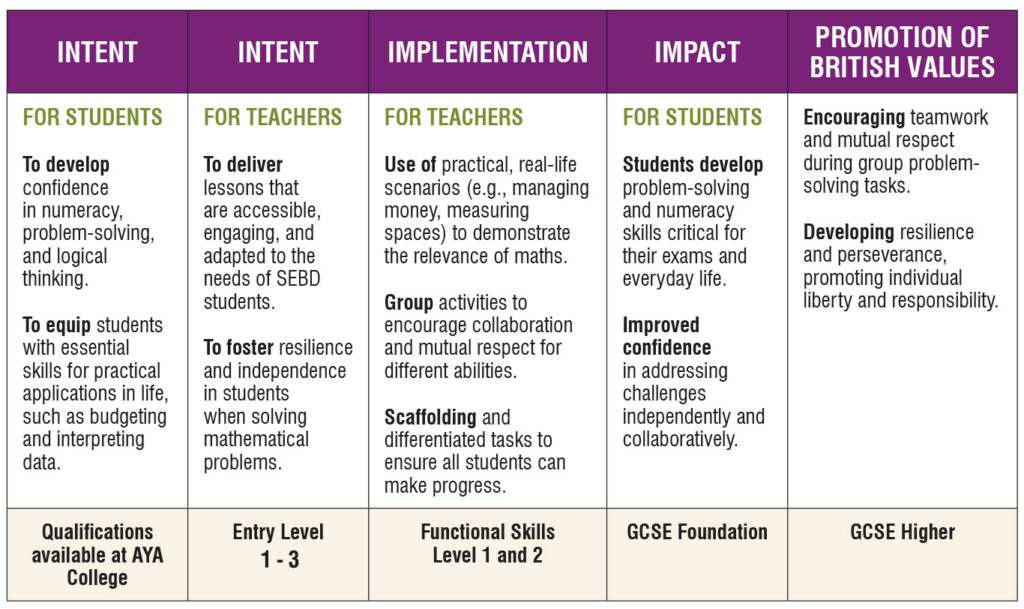
- Individualised Learning: Lessons are tailored to meet each student’s ability and pace, ensuring accessibility for all.
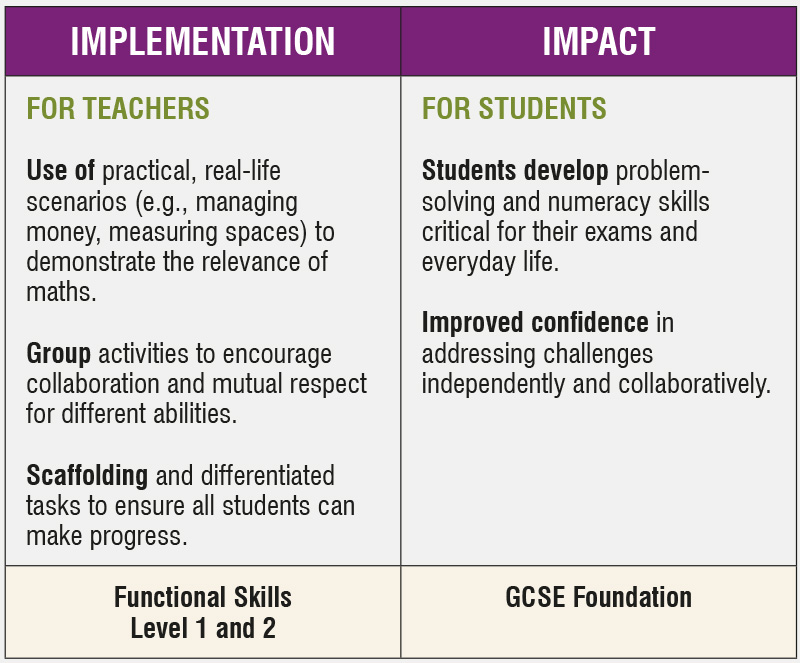
- Engagement Through Context: Real-life scenarios and practical activities are integrated to make maths relevant and meaningful.
- Confidence Building: Small, achievable milestones are set to reduce anxiety and foster success.
- Supportive Environment: Therapeutic approaches are embedded to help students manage emotional and behavioural challenges during lessons.
Goals:
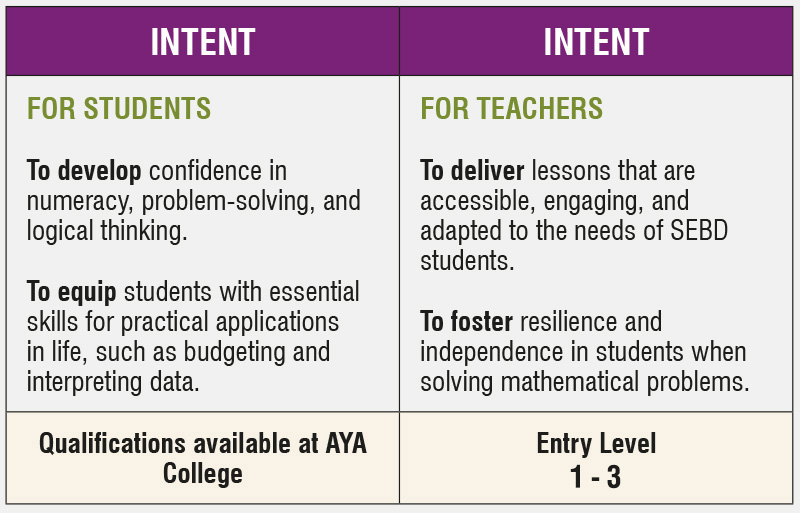
- Build confidence and resilience in maths.
- Ensure students acquire foundational skills necessary for progression to KS4.
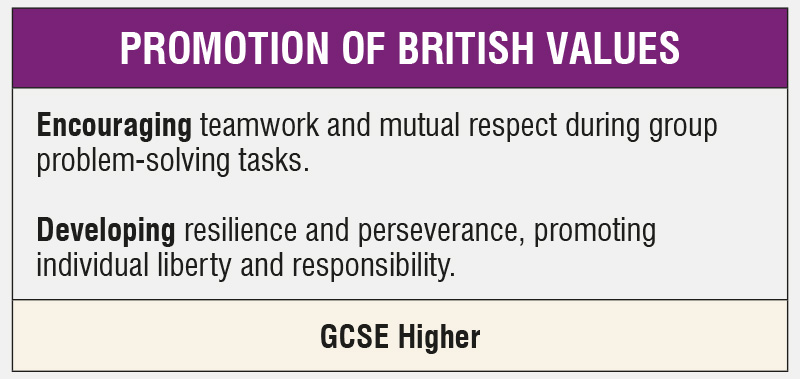
- Encourage problem-solving, logical thinking, and collaborative work.
Key Stage 4 (KS4): Preparing for Qualifications and Beyond
At KS4, the curriculum focuses on consolidating prior knowledge, advancing to more complex topics, and preparing students for GCSE or Functional Skills qualifications.
Core Topics:
- Advanced number work: percentages, ratios, and proportional reasoning.
- Algebra: solving equations, inequalities, and exploring graphs.
- Geometry: area, volume, trigonometry, and transformations.
- Probability and statistics: analysing data, probability calculations, and making predictions.
- Real-world maths: budgeting, time management, and interpreting data.
Approach:
- Exam Preparation: Structured lessons focus on GCSE content and include revision sessions, mock exams, and past paper practice.
- Functional Skills Pathway: For students who require a more practical approach, Functional Skills Maths is offered as an alternative pathway.
- Practical Applications: Real-world scenarios, such as managing finances and understanding data, are prioritised to prepare students for life beyond school.
- Personalised Support: Small group or one-to-one interventions address individual areas of difficulty and build confidence.
Goals:
- Prepare students for GCSE Maths or Functional Skills qualifications, tailored to their individual needs and aspirations.
- Equip learners with mathematical skills applicable to further education, employment, and everyday life.
- Promote resilience and independence in tackling mathematical challenges.
SEBD Considerations Across KS3 and KS4
- Therapeutic Approach: Lessons are structured to reduce anxiety and create a safe environment for learning. Emotional and social support is embedded into the curriculum.
- Flexible Delivery: Teachers adapt lessons to meet the needs of students, using creative and interactive methods to maintain engagement.
- Positive Reinforcement: Achievements are celebrated, no matter how small, to motivate students and build self-esteem.
- Real-World Relevance: Maths is taught with a focus on practical applications, helping students understand its importance in everyday life.
Overall Impact
The Maths curriculum at Aya College aims to:
- Foster a growth mindset that empowers students to overcome challenges and embrace learning.
- Develop confidence, independence, and a sense of achievement in mathematics.
- Equip students with the skills they need for further education, employment, and independent living.
- Prepare students to achieve nationally recognised qualifications, ensuring they leave Aya College with the tools to succeed in the future.
By offering a nurturing and individualised approach, Aya College ensures that all students, regardless of their starting point, are given the opportunity to thrive in mathematics.